
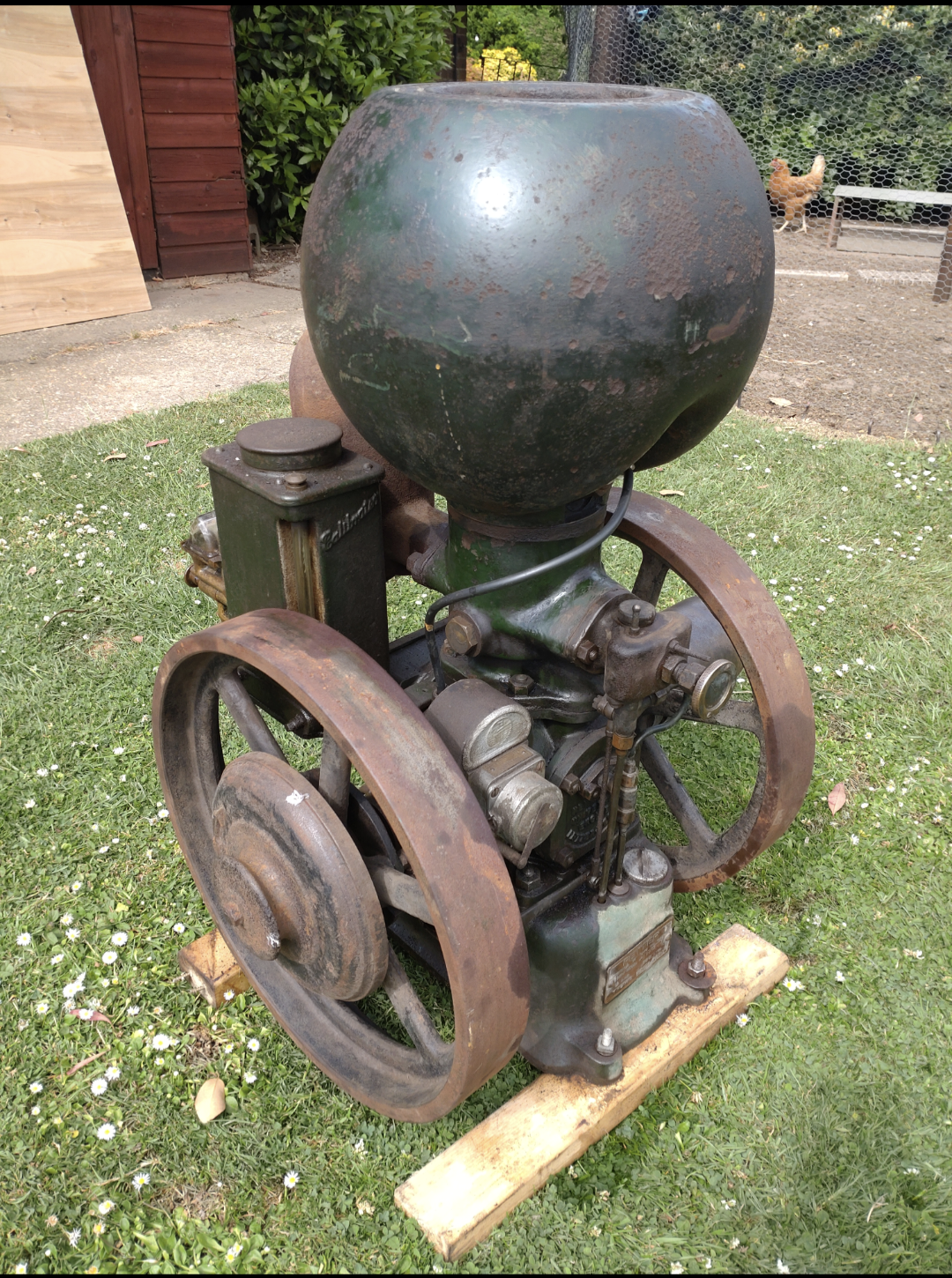
Back in June 2023 I acquired a Petter M type from a friend who had helped clear a collection in the North of England.
Upon having a look, the engine appeared to be in good original condition, complete and a quick check revealed it to have a good spark. I was assured that it had been running recently, although due to the fuel in the tank being a bit stale it refused to start. Never mind, a deal was done and home it came.
A quick check over and some fresh fuel in the carb resulted in it starting up and running reasonably well, although only for a minute or so before I switched off.
I was planning to do a bit of recommissioning and take it to the next show as it was, but I thought I’d better have a quick check inside first, just to make sure…… good job I did!
The big end was found to be loose, with the brass shells partially rotating in the rod, with quite a lot of play in them. At this point I decided it was going to need a full strip down to make sure everything else was okay.
Forward a few months and the strip down began.
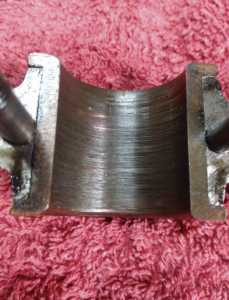
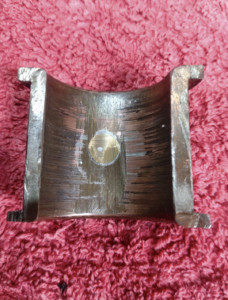
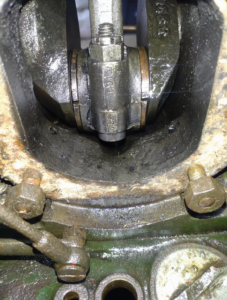
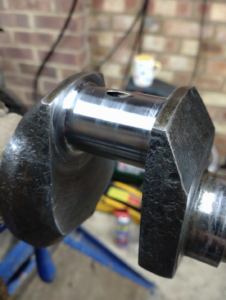
The brass big shells looked like they had been adapted from something else, the anti-rotation hole had been filled in with braze, and neither shell really fitted the rod properly. Both shells were badly scored and showed signs of heat. Fortunately, the crank journal, which are notoriously soft on these engines, was only lightly scored, and a quick measure up revealed only .001″ ovality.
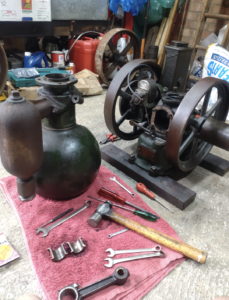
The engine was completely stripped over the next few days, with everything being laid out in order, ready for cleaning and inspection.
The big end issue was going to be a problem, parts for these small M types are not very plentiful, and I had made a few enquiries about a pair of new white metal shells being made when a friend luckily came up with a spare rod with good shells in. The rod itself was very corroded, but the white metal shells came out okay and showed to be in almost unworn condition.
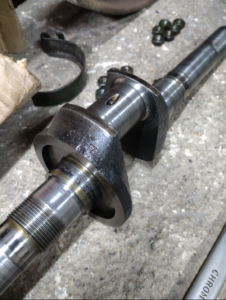
My rod was cleaned and prepared ready to receive the replacement shells, meanwhile the crank was cleaned, the big end journal was carefully trued up with a smooth file followed by emery cloth and with much polishing and checking with the micrometre it was back to being round and parallel. The shells were fitted to the rod and then blued and scraped to give around .0015″ clearance all around.
Over the next few weeks, I went through all the other parts of the engine, cleaning and checking and amazingly everything else was found to be in very good condition, with virtually no wear anywhere.
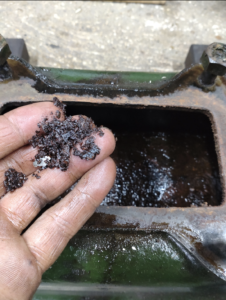
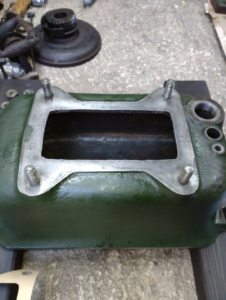
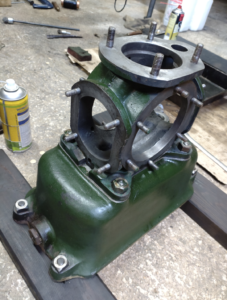
The base tank was cleaned of all its rust and sediment and the crankcase thoroughly cleaned and all joint faces polished. At this point the original paper gaskets were measured and remade from identical thickness paper.
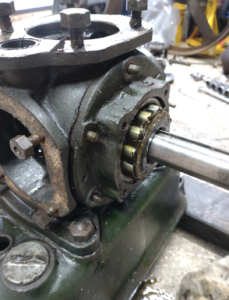
The ball and roller main bearings were cleaned and examined and found to have no wear and the felt oil seals were removed, washed and resoaked in oil before being refitted.
The engine began to be slowly reassembled, with everything clean.
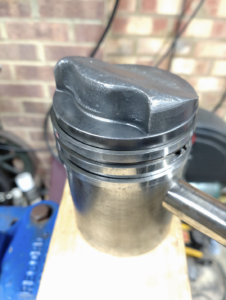
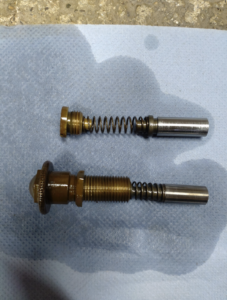
The carburettor was fully stripped and the nozzle carefully cleaned. The piston and rings were found to be in good order and were cleaned and polished ready for refitting.
The Calibrator oiler unit was drained and fully stripped, each part cleaned and reassembled. It was then rotated with the electric drill at running speed and the oil delivery checked and the drip rate set.
The magneto was in good order, so I only cleaned and set the points gap before giving it a polish externally and refitting.
All the other small parts were cleaned, governor weights and linkages were reassembled with new split pins throughout.
The cylinder bore was given a good scrub with coarse emery cloth to deglaze it and all the water passages flushed out with the pressure washer. 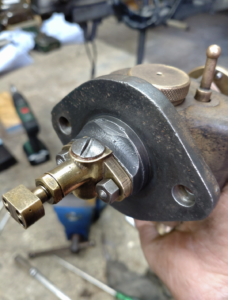
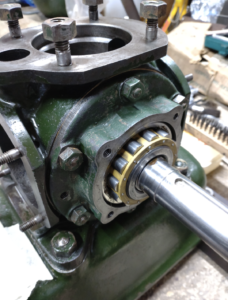
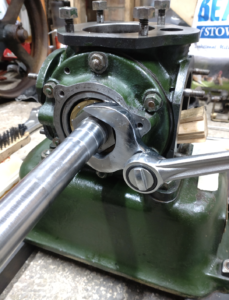
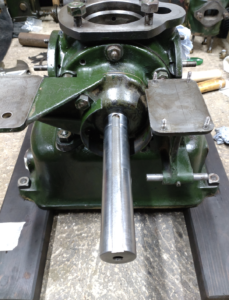
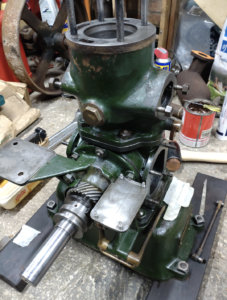
Reassembly was straightforward, with new gaskets throughout, the main bearings were packed with grease and the locknuts and tab washers secured.
Once the piston and rod were back in the cylinder some measurements were taken so that the fuel nozzle could be adjusted to give the correct distance from the piston. The diaphragm for the fuel pump was found to be in good order, with no corrosion, so it was refitted with new gaskets.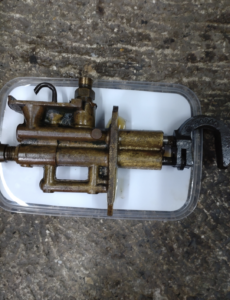
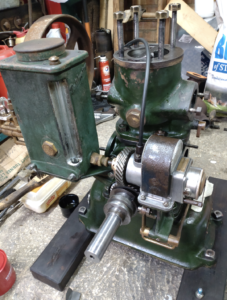
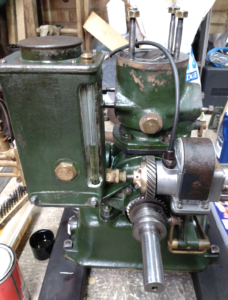
A new head gasket was obtained and the head/hopper refitted and the nuts torqued down.
The air filter unit was cleaned and fitted with some new filter material before being refitted.
With a few smaller parts fitted the engine had now reached the point for a run.
Fuel tank filled, and everything lubricated, the engine was cranked over for a few minutes to prime the oiling system, at this point the carburettor had filled which proved the pump was working okay.
With the fuel valve opened the engine was given a rapid crank and I was pleased to see that it fired up and preceded to settle to a steady running speed. The fuel valve closed a little resulted in a steady rhythm.
During the initial runs the crankcase door was removed several times and the big end checked for any heat, and to ensure that oil was reaching it.
Successive runs became longer, with the drip rate from the Calibrator being finally set. The head nuts were re-torqued and over the next few days the engine was given several longer runs, with some gentle load being applied which resulted in a lovely burble from the exhaust as it fired on every stroke.
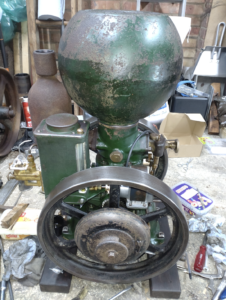
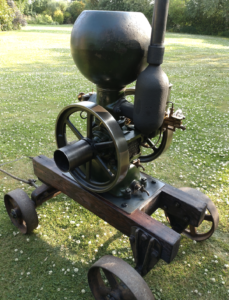
The engine was fitted to a Lister trolley, being mounted on a piece of 1/4″ plate to avoid drilling extra holes in the trolley. This makes it very easy to move around and despite the mixture of manufacturers actually quite suits the engine!
It was taken to a couple of shows last year and also to the magnificent Petterfest where it ran faultless all day.
The history of the engine according to the records is that it was dispatched on 24 May 1935 to John Fowler & Co, Leeds. Presumably to be fitted to a small cement mixer, as it was one of a batch of 6 fitted with “Fowler spec” air filters.
If it was fitted into a mixer, I can only say that it never saw much use, as apart from the big end issue, the rest of the engine shows virtually no wear and the original paint has remained in very good condition.
It has made a nice addition to the collection and hopefully will be joined by my Acorn top model which is awaiting the same treatment.
You must be logged in to like this post.
Country: GB