
These are my observations on Lee Howl water pumps, nice pumps these,but people struggle with identification on them due to most having no name cast in them but from what I’ve seen, there are certain things that makes these particular pumps easy to identify.

Jonathan Edwards Howl planned to start an engineering business at Tipton but unfortunately died before his plans really took off, his oldest son, Edmund took over his father’s dream and formed a partnership with William Lee, an experienced businessman, Thomas Henry Ward, a design and construction engineer and finally Oliver Howl, Edmund’s youngest brother, this was 1880ish and the company name was a bit long winded at “Lee, Howl, Ward, and Howl” the name was changed in 1887 when Thomas Ward retired.
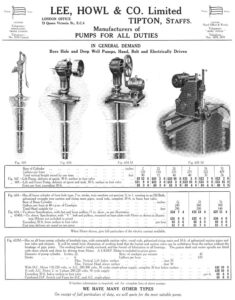
The company grew, building steam pumps for drainage work in mines etc as well as designs on other things like boilers and even making parts for trams!

As usual war made the company change its products and they went into the production of munitions to help with the war effort but still carried on manufacturing pumps in all sizes.
So, back to the pumps, I’ll start with the Super Major as this is quite a common pump and is often seen on the rally field, this is easy to identify as it normally has a large single vee pulley fitted with 6 spokes, the air vessel in top sits proud and can be easily broken off, valves access is via 2 brass bungs on the bottom side of the pump casting with the top valves accessed under the casting that holds the air vessel, there is a second “vessel” on the intake side that is actually a weir and holds water in the pump when the inlet pipe is disconnected.

Pump seen here from the pulley side showing the plugs in the bottom of the pump casting

Back side showing the inlet, unfortunately my pump is missing the second vessel.

Another good way to identify the Lee Howl pump is the flag emblem cast into the body somewhere.

Just to throw a spanner in the works, these pumps are also seen badged as Boulton & Paul (photo found online) badge engineering or did B&P buy the plans? This photo of the B&P pump shows the second vessel very well.
These pumps, although small do have 1″ pipe work and can move a fair bit of water.

Probably the next most common pump seen is the “Compactum” this is a gear driven pushrod/cross head type pump very similar to look at in first glance as the Climax style of pump but there are differences, the Lee Howl has the layshaft fitted between the big gear and the air vessel, the Climax has the layshaft behind the large gear towards the back of the pump, this makes for a more compact design of the Lee Howl, maybe that’s where the “Compactum” name comes from.


Again with these pumps the flag emblem can be seen on the air vessel giving a hint as to who built it, plus the name Compactum is normally cast on the pump cylinder.


Another thing I have noticed is the spokes on the Lee Howl pumps have their own design, they are a square section spoke when most other pumps are more rounded, I have a well head made by Lee Howl that has the same spokes.

Another Lee Howl I have, that as yet I’ve done nothing with, is a horizontal one, the likes I can’t recall seeing, picked this up a few months ago for a nice cheap price. Has the 2 air chambers like the Super Major but it’s a fair bit larger, unfortunately the lovely square spoked pulley is missing, however the flag is very much on there so there is no mistake it’s a Lee Howl


So there we are, just some ramblings from the shed on a wet Monday afternoon, hopefully some of these tips will help if you ever get a pump and don’t know who built it.
And finally, my 4″ Compactum at Woolpit Steam rally 2025 being driven by my Peartop
You must be logged in to like this post.
Country: GB